Showing posts with label MA. Show all posts

Tuesday, May 8, 2018

Duxbury’s North Hill Marsh


(Note: This article was originally published in October 2013, but was inadvertently left out of this blog.)


For years I have avoided Duxbury’s North Hill Marsh because on my first visit, more than a decade ago, I got lost.

When visiting a conservation area that is new to you, it is always wise to consult a map, and even wiser still to bring a map along. I did that on my second visit to North Hill Marsh, and I enjoyed the walk immensely. Even after 90 minutes I found there was plenty more to explore, so I will definitely be going back.

Located on Mayflower Street, the North Hill Marsh Wildlife Sanctuary is managed by both Mass Audubon and Duxbury Conservation. The town owns 823 acres of pine/oak woods and wetlands, while Audubon oversees another 30 acres of upland, plus 90 acres of reservoir and marsh. Together they provide an ideal location for walking, birding and wildlife observation. 

A map of the property is available online. Its sidebars offer a quick history of the land, as well as an overview of the wildlife present there.

I learned from the map that the reservoir at the center of North Hill Sanctuary – as well as the freshwater marsh that surrounds it – was created centuries ago, when the town’s early European inhabitants dammed a brook to power a sawmill and provide water to farms nearby. In the 1920s, ownership transferred to a group of sportsmen, who used the area for duck hunting. A second dam, constructed in 1940 as part of a cranberry growing operation, raised the water level in the pond even more. Mass Audubon now maintains the property as wildlife habitat, thus dead trees are left standing (or lying down, as the case may be), to encourage waterfowl to feed and breed. You might see osprey at North Hill Marsh, as well as great blue heron, black-crowned night heron, great horned owl, red-tailed hawks, and any number of geese and ducks.

The shallow edges of the pond are an ideal location for spotting salamanders, frogs, and turtles, and in the warmer months, there are plenty of dragonflies and damselflies. The small mammals so common to our region – squirrels, chipmunks, mice, raccoons, opossums --  are joined at North Hill by water-loving muskrats, mink, otters, plus coyote and deer, although  many of these you are unlikely to spot in broad daylight.

A well-marked Loop Trail extends all the way around the pond, closely hugging the shoreline in many places. Portions are flat, but some of the trail involves elevation, so it can be a satisfying hike for those hoping to get the heart pumping. There is also a shorter loop through the woods, plus a path than runs more or less parallel to Mayflower Street, through the Frederick B. Knapp Town Forest, which is comprised primarily of tall pines. Additional spur trails connect the property to West Street and Tremont. Visiting the Waiting Hill Preserve, in the northern quadrant of the property, involves a climb to the top of the town’s second-largest hill, which stands at 140 feet above sea level. Alas, trees obscure what otherwise would be a broad view of Duxbury Bay.

North Hill Marsh welcomes visitors daily from dawn to dusk. Boating, fishing, hunting and trapping are not permitted, nor are motorized vehicles. Dogs must be kept under control at all times. 

Follow this link for a map and property guide.
http://www.town.duxbury.ma.us/public_documents/DuxburyMA_Conservation/ConAreas/North%20Hill%2027%20Oct.pdf

by Kezia Bacon
October 2013

Kezia Bacon's articles appear courtesy of the North and South Rivers Watershed Association, a local non-profit organization devoted to the preservation, restoration, maintenance and conservation of the North and South Rivers and their watershed. For membership information and a copy of their latest newsletter, contact NSRWA at (781) 659-8168 or visit www.nsrwa.org. To browse 15 years of Nature (Human and Otherwise) columns, visit http://keziabaconbernstein.blogspot.com

Wednesday, July 31, 2013

Whale Watch!

-->

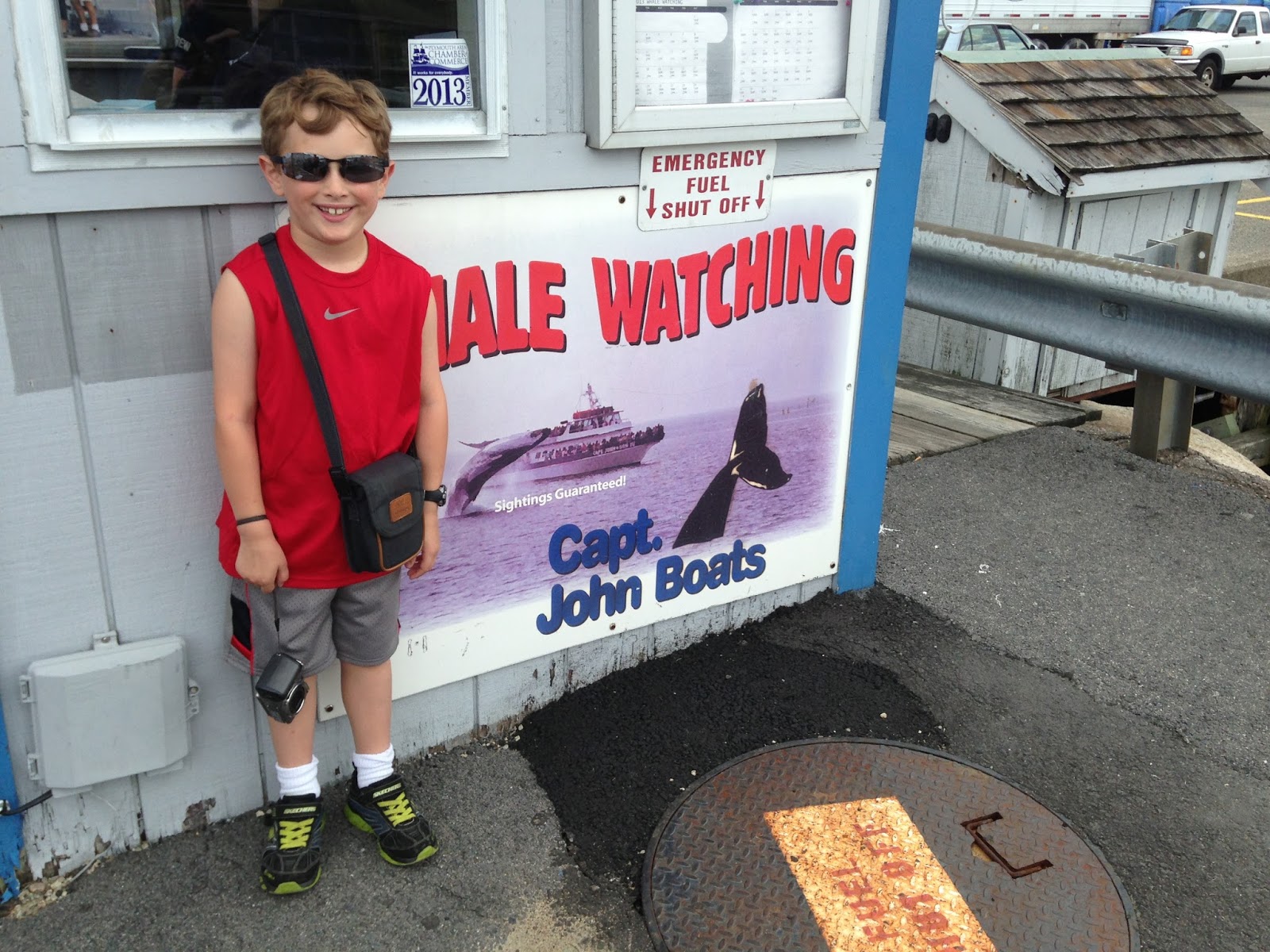
 Summer vacation is short this year – only eight weeks. At the end of June, I make a list of the things I want to do with my son this summer. Going on a Whale Watch is right at the top, and we get right to it, heading out of Plymouth Harbor on a Captain John Boat only two days after school ends.

I have to admit, I am nervous. I’ve been on whale watches only twice before, both in middle school. For the first one, it was really cold on the water, and I wasn’t dressed properly. The whales we saw were too far away to make an impact on my seventh-grade self. For the second one, a year later, it was dark and rainy, and my lasting memory was of getting seasick. So for this trip, I am staving off worried visions of a bored son and his woozy mother.

The forecast is not great as we head down to Plymouth – showers and a chance of thunderstorms. It’s some consolation that it’s the same forecast we often have in the summer around here, with the stormy weather only materializing about half the time. The sky is blue, and with a bag full of snacks, rain gear, and warm layers, we – my son, my mother, my uncle and I -- are as ready as we can be.

We board the boat and find seats up top, for the best view. After a quick safety review, the on-board naturalist and her assistant give us an overview of the geography of Cape Cod Bay and Stellwagen Bank, as well as a primer on the types of whales we might see at this time of year.

It’s an hour’s journey out to Stellwagen Bank, which is a primary feeding ground for whales. There’s plenty to learn along the way, with landmarks such as Plymouth Rock, Bug Light, Clark’s Island and Saquish all within view. We pick up speed as we hit the open ocean. It’s exhilarating and refreshing . . . especially since we are leaving behind some oppressive humidity.


The boat slows as we approach another touring company’s vessel. Our guide advises us to look off to the right, and everyone on the top deck moves to the railing on the starboard side and peers off into the distance. And then there it is! A finback whale surfaces and dives, surfaces and dives. The guide explains that a whale will do this three or four times in a row, so we continue to watch, and there it is again, surfacing and diving one more time before it disappears into the sea.


We spend the next hour shifting, en masse, from one side of the boat to the other, following the cues of our guides. We watch one finback for a while, then give it a break, and motor off to another likely location for a sighting. Then we are treated to a similar series of appearances by another finback. The Captain John company participates in the Proud Whale Sense program, and follows the guidelines intended to prevent harassment of wildlife, so we don’t stay with any single animal for very long.

Dark clouds move in. The guide advises us to take cover, and most of the passengers go down into the enclosed lower level, where there are windows, restrooms and a snack bar. My son and I hang out down there for a little while, but he grows restless, so we go back up top. It’s raining, but not very heavily.

Soon, a minke whale makes a brief appearance . . . but then nothing more. We are now about 2.5 hours into the four-hour tour, and my seven year-old is getting antsy, so we decide it’s time to explore the boat. We find our way out onto the small observation deck at the bow, on the lower level, just in time to see the minke surface again, about ten feet away! Amazing! It was interesting to see whales from a distance, but right up close like that is something else entirely. Thrilling. We have definitely gotten our money’s worth now.


It’s still raining, and soon it is time to head back to shore. The captain puts the boat into high gear, and we enjoy watching the wake pattern as we motor back toward land. In time, the rain passes, and the sun begins to emerge from the clouds. We arrive in Plymouth Harbor refreshed -- and delighted to have seen a minke whale so close to the boat.

If you’re contemplating a whale watch, you can find out about schedules and prices on Captain John’s website (http://captjohn.com/). The tours run through the end of October. For more specific information about daily sightings, check out the staff naturalists’ blog (http://captainjohnboats.blogspot.com/) where there are narratives about some of the whale watch trips, and lots of photos.

by Kezia Bacon
July 2013 

Kezia Bacon's articles appear courtesy of the North and South Rivers Watershed Association, a local non-profit organization devoted to the preservation, restoration, maintenance and conservation of the North and South Rivers and their watershed. For membership information and a copy of their latest newsletter, contact NSRWA at (781) 659-8168 or visit www.nsrwa.org. To browse 15 years of Nature (Human and Otherwise) columns, visit http://keziabaconbernstein.blogspot.com