Showing posts with label Massachusetts. Show all posts

Tuesday, April 3, 2018

Should We Ban Plastic Bags?


You know how when you enter the grocery store, there’s a receptacle where you can recycle your plastic shopping bags? I always see it and think, “That's a good idea. I should bring mine.” I’ve actually succeeded in this mission only once, though: partially because I forget, partially because I try to use my own shopping bags as much as possible, and partially because any plastic bags I bring home end up being repurposed for trash disposal.

When I first began reading about municipal bans on single use plastic shopping bags, I shrugged. It didn’t seem like it would be successful.  People are reluctant to give up their conveniences, and getting into the habit of always having a shopping bag with you is a lifestyle shift. Paper bags create waste too (and kill trees), so relying on those isn’t a sound alternative.

But then I started reading about plastic bag bans actually going into effect . . . and not just in places like Europe, China, and California, but major cities like New York, Los Angeles, DC, and Chicago, . . . and small towns too. Right here in Massachusetts, there are 64 cities and towns with restrictions on single use plastics bags. Plymouth banned them in February 2017, and Duxbury’s ban went into effect this past January. Boston’s ban begins at the end of the year. It was time for me to start paying attention. So I did some research. Here’s what I learned.

How Many Bags?
Every year, Americans discard 100 billion single use plastic bags. According to a survey in 2012 by the Mass Food Association, a grocery industry group, the average market in Massachusetts dispensed 2,682,643 plastic bags, or 51,000 per week. The typical amount of time each bag is in use is just 12 minutes. No more than 14% are recycled. These bags are our third largest source of litter, behind cigarette butts and bottle caps.

Where Do They Go Next?
What happens to these bags when we’ve discarded them? They don’t just disappear. Plastic can be recycled, but it doesn’t biodegrade. Instead, over time, it breaks down into increasingly smaller fragments, eventually becoming particles of microplastic that can do grievous harm to animals, the oceans, and our environment in general. That’s why bans on single use plastic bags are important.

Why Are Plastic Bags A Problem?
• From the start, single use plastic bags are harmful to the environment. The oil or gas required to produce them, and the greenhouses gases released during production, simply do not justify their very short lifespan. We’re depleting non-renewable resources in order to make bags that continue to do harm in their afterlife.

• It takes 200+ years for a single use plastic bag deposited in a landfill to decompose. During this time it releases methane gas and carbon dioxide. If incinerated instead, it releases, toxic fine particles into the air.

• In the oceans, where many of these bags ultimately end up, tiny fragments of plastic are consumed inadvertently by fish and other sea animals. These toxins move up the food chain, eventually appearing -- too small for us to see or taste them -- in the fish we eat.

• Have you heard about the colossal gyres of plastic trash floating in our oceans? One, off the coast of California, is estimated to be 1-2 times the size of Texas! To date, there is no effective way to clean these up. Which unfortunately means that sea animals are dying off in great numbers – about 100,000 dolphins, seals, turtles, porpoises and whales per year – plus another 2 million birds – all from ingesting, or becoming entangled in, single-use plastic bags.

What Kinds of Bags Get Banned?
Single use plastic shopping bag bans are becoming increasingly popular because they significantly decrease plastic waste while encouraging the use of more sustainable (often cloth) shopping bags. These bans don’t prohibit heavier plastic bags, nor the ones used as barrier for fresh meat, nor those used for produce, newspapers or dry cleaning. The only bags banned are the thin single use plastic disposable type most commonly found at grocery store checkouts. Recyclable paper bags remain available at no cost to the consumer, plus many stores sell inexpensive reusable shopping bags.

How Does The Ban Work?
Some plastic shopping bag bans apply only to stores larger than 3000 square feet, or stores with more than one location in a town. Others, like Marshfield’s affect all stores. When enacted by the town and approved by the state Attorney General, these bans allow stores 6 months to deplete their plastic bag stock, plus they can apply for an additional 6-month grace period.

How Can I Help?
• If you live in Marshfield, support the single use plastic bag ban, which is on the warrant for the April 23rd Town Meeting. The Board of Health, who is the enforcing agent, has given its unanimous approval. Jeanne Ryer, a spokesperson for Marshfield’s Plastic Bag Reduction Group said, "If you believe that personal freedom comes along with personal responsibility to care for our community and environment, that the two are inseparable, then you have a choice to make. We hope that once you understand the degree of the problem that exists, you will support this ban.”

• If you live in a town that does not presently ban these bags, you can still choose not to use them personally. You might also advocate for a ban in your own town. 

by Kezia Bacon 
March 2018 

Kezia Bacon's articles appear courtesy of the North and South Rivers Watershed Association, a local non-profit organization devoted to protecting our waters. For membership information and a copy of their latest newsletter, contact NSRWA at (781) 659-8168 or visit www.nsrwa.org. To browse 20 years of nature columns, visit http://keziabaconbernstein.blogspot.com

-->

Tuesday, May 31, 2016

Rattlesnakes in the Blue Hills!

A view from the Skyline Trail in Blue Hills Reservation.
It was a bright afternoon in May. I was hiking up a steep trail near the crest of Buck Hill in Milton, noticing about how warm the rock ledge at my feet felt, having absorbed the heat of the sun all day, and musing on how nice it would be to lie down upon it. And then I remembered that snakes like to stretch themselves out over warm rocks too . . . And that I had read something recently about rattlesnakes in the Blue Hills. . . And that maybe I should watch my step.

Given the fact that there were probably a hundred other hikers on the trail to Buck Hill that day, there wasn’t any cause for concern. Snakes don’t gravitate toward well-trafficked areas. But it got me thinking that I should educate myself more thoroughly on the matter. To put it mildly, I’m not fond of snakes. It would be better to know what to expect than to ruin a hike by imagining them lurking around every corner!

We typically associate rattlesnakes with the desert, and do not expect to encounter them close to home. However about 200 timber rattlesnakes currently reside in Massachusetts. Most often they inhabit wooded mountainous areas with steep rocky ledges and ample populations of rodents . . . although they are sometimes found in fields and wetlands too. Populations in our state are concentrated in the Berkshires, the Connecticut River Valley and the Blue Hills. Nationwide, they make their home throughout much of the eastern US, as far west as central Texas in the south, and to Wisconsin in the north. While they are abundant in the southern Appalachians, here in the northeast, populations are quite small.

The timber rattlesnake hibernates for the colder half of the year, but becomes active in Massachusetts around the middle of April. After emerging from the underground crevices in which is spends the winter, it makes its way onto rock ledges where it can bask in the sun to keep warm. (Like many snakes, the timber rattler is ectothermic, meaning it cannot regulate its own body temperature.) In the spring, activity is minimal, although some mating does occur. After mating, the snakes move away from the den -- males to dense forest, where the hunting is good; females to fields and less-dense forest, where temperatures are warmer. Baby snakes are born alive after about 4-5 months. They all return to the den in September or October, depending on the weather. The average life span for a timber rattlesnake is 10-15 years.

A brown Timber Rattlesnake. (Photo credit Anne Stengle/Mass Wildlife)
 The standard description of a timber rattlesnake includes the phrase “pit viper,” which sends chills up my spine. If you’re imagining a teeming pit of angry, venomous snakes (as I first did), please take my hand and we’ll back away from that erroneous image together. A timber rattlesnake is large – three to five feet in adulthood, 8-16 inches a birth, with a broad triangular head and rough-looking scales. It can range in color from black or brown to rust or dark yellow. The underside is light in color, sometimes with dark flecks. It has bands across its back and sides, but none on its head or face. Its tail is solid black, with a rattling structure at its end that grows with each successive shedding of skin, but is sometimes lost in that same process. The term “pit viper” refers to the pits on either side of its head – super-sensitive nerve endings that can detect radiant heat.

Timber rattlesnakes don’t eat people. Not even small ones! They prefer mice, chipmunks and other warm-blooded rodents, plus sometimes birds, bugs and amphibians. They hunt by day in the spring and fall, but become nocturnal in the summer, when their prey becomes more active at night. Here the sensory pits are especially useful – they help the snake to detect warm-blooded prey in the dark. Timber rattlesnakes see pretty well, especially when an object is moving, but they can also track prey via its scent, or by sensing vibrations in the ground.

A timber rattlesnake has two large fangs at he front of its mouth, plus a number of smaller teeth along its jaw. The fangs, which fold back onto the roof of the snake’s mouth and are covered by a sheath when the jaw is closed, are conduits for venom. Hunting consists primarily of lying motionless – watching and waiting -- with intervals of prowling. Attacking prey comes first. Injecting venom, the volume of which the snake can control, is a secondary measure.

When it comes to humans, a timber rattlesnake will strike and bite only as a last resort. When disturbed or threatened, it will rattle its tail, which should be enough to send most people packing. The timber rattlesnake prefers to be left alone, and will back away from a human if possible. It will probably fight back if touched, though. It’s helpful to know that the last reported fatality from a timber rattlesnake bite in Massachusetts was in 1791.

Due to declining populations, the timber rattlesnake is now an Endangered Species in Massachusetts. Its habitat has been diminished over the years, and a lot of lives have been lost through ill-fated road crossings. Just as much of a threat, however, is hunting. Whether it’s snake collectors, or people who come upon a snake and kill it out of fear, timber rattlesnake numbers have been greatly reduced in the past 25 years.

You may have heard recent news reports about a statewide effort to protect timber rattlesnakes. They would be captured in the wild as newborns, raised in captivity (at the Roger Williams Zoo) and then released to their birth area when they are old enough to fend for themselves. (This would amount to no more than ten snakes released per year.) Nothing controversial, until the release plan changed and there was talk about designating Mt. Zion, a 1400-acre island in the Quabbin Reservoir without human access, as their new home. “Rattlesnake Island” sounds like a horror movie, so there was a fair amount of public outcry. The issue remains undecided.

Sources:


by Kezia Bacon
April 2016 
 
Kezia Bacon's articles appear courtesy of the North and South Rivers Watershed Association, a local non-profit organization devoted to the preservation, restoration, maintenance and conservation of the North and South Rivers and their watershed. For membership information and a copy of their latest newsletter, contact NSRWA at (781) 659-8168 or visit www.nsrwa.org. To browse 20 years of Nature (Human and Otherwise) columns, visit http://keziabaconbernstein.blogspot.com


Tuesday, December 29, 2015

Our Backyard Swans

photo by Sandy Bacon
-->
When I was growing up, my family visited the Swan Boats in the Boston Public Garden somewhat regularly – usually on Mother’s Day. For years, I thought of the swan as a rare species – something one could only see at a special place -- never in the wild. But then in the 1980s a pair of swans took up residence in “the pond” behind our house. They -- and their successors -- have pretty much been there ever since. Elegant, with long curving necks and a seemingly serene demeanor, they always manage to capture our attention.

“The pond” behind our house is actually a wide upstream portion of the Green Harbor River. It is relatively secluded -- bordered in large part by the Hoyt-Hall Preserve, a parcel of conservation land managed by the Wildlands Trust of Southeastern Massachusetts. There are a few private homes along the riverbanks as well, and also the Garretson cranberry bogs. It often feels like the swans out back are “ours,” as there are only a few people who can see them!

It turns out that swans are not especially rare in our part of Massachusetts, and while technically they are an exotic species – meaning they are not native to our region – they’re somewhat commonplace. That doesn’t make them any less captivating, though.

Our region’s swans are members of the species Cygnus olor -- the mute swan. They were brought over from Europe and Asia to the United States in the late 1800s for use as living, breathing pond ornaments in parks and on private estates. The prevailing assumption is that some of them found their way into the wild, and gave rise to a slowly-increasing population. Today mute swans can be found up and down the coastline from Maryland to Massachusetts. Here in our state, they are concentrated primarily on Cape Cod and the Islands, with a decent number from Plymouth to Cohasset as well.

Up until the 1970s, mute swans were indeed rare to these parts. But the Massachusetts Audubon’s 1974 Christmas Bird Count identified 200 individuals in the state, and by the mid-eighties, there were 135 mating pairs, with closer to 600 in the winter, due to migration. (They seek refuge in unfrozen ponds and bays.)

The mute swan is striking. Its size alone is impressive. One of the heaviest of the flying birds, a typical adult male weighs from 20-32 pounds and extends to 55-63 inches in length. That’s more than five feet! The mute swan is completely white in color, save for its orange and black bill. Despite what its name suggests, it isn’t actually mute, but it is known to be quieter than other swan species. Still, it grunts and snorts and sometimes makes a hoarse whispering sound, and will hiss at predators such a snapping turtles and coyotes. Its wing flaps are loud, though. We frequently hear “our” swans taking off in flight.

Young swans are called cygnets. They are usually not stark white, but rather gray or off-white. The beak doesn’t turn orange until after the first year. Cygnets make more noise than their parents -- they will chirp and whistle and even squawk if in danger.

You may have heard that swans mate for life. It’s a romantic notion, and true too (mute swans are indeed monogamous), but their lifespan averages just 6-10 years. Mute swans typically inhabit coastal ponds and tidal creeks, and often return to the same nest year after year. They build large nests in shallow water or on islands within ponds and lakes, foraging for materials nearby. One advantage of their long shapely necks is their ability to harvest and feed on submerged aquatic plants.

A female mute swan lays eggs in April or May – 4 to 6 at a time – and then sits on them for 5-6 weeks. The male stays close-by, and when the cygnets hatch, the family stays together for 15 weeks before the young are able to fly. The mortality rate is high. Due to extensive predation, most cygnets do not survive.

As beautiful as they are to behold, mute swans are not friendly. They’re protective and territorial, and will attack even a human if it gets too close. If a mute swan senses another creature encroaching upon its territory, it may rush at it, attempt to bite it, or perhaps assault it with the spurs on its wings. That probably explains why, after all these years, we’ve never seen more than one family of swans on our pond at a time.

While state regulations deem it illegal to hunt them, mute swans aren’t exactly a favored species here in Massachusetts. Non-native, they are considered to be invasive as they drive other, more welcome, species out of their natural habitats. Swans can also be a nuisance to farmers, as they not only consume cereal crops such as wheat, they also trample them. Swans are best left undisturbed, but if you have a serious problem with them on your property, contact Mass Wildlife for assistance (508-759-3406).

by Kezia Bacon
December 2015 

Kezia Bacon's articles appear courtesy of the North and South Rivers Watershed Association, a local non-profit organization devoted to the preservation, restoration, maintenance and conservation of the North and South Rivers and their watershed. For membership information and a copy of their latest newsletter, contact NSRWA at (781) 659-8168 or visit www.nsrwa.org. To browse 19 years of Nature (Human and Otherwise) columns, visit http://keziabaconbernstein.blogspot.com

Sources:

https://en.wikipedia.org/wiki/Mute_swan

Tuesday, April 14, 2015

Turkeys Everywhere!

-->
Turkey footprints in the snow. You can't tell by the photo, but they're quite large!

One morning before sunrise, I heard the strangest sound. It was a gurgling noise, medium-pitched, definitely from an animal . . . and it sounded like it was coming from up in the trees. Wondering for a moment if the neighbors had gotten chickens, it came to me. It wasn’t a gurgle, it was a gobble! Turkeys.

Last fall wild turkeys were everywhere – or at least that’s how it seemed here in my neighborhood in Marshfield. Our property borders woods and wetlands, so we see all sorts of creatures pass through. At first the turkeys roamed in flocks of up to 50 – yes, fifty! – but the numbers decreased dramatically as the season wore on. Given the bold way they crossed even the busiest roads, I imagine the thinning was due as much to jaywalking as predation.

We didn’t see much of them as winter began, but after the first major snowfall in January, they were back. Perhaps they were here all along, lying low. Perhaps the snow drove them out of their natural habitat and onto the roads – the only bare ground available. I was often amused to see them racing up the street ahead of my car -- their own version of our annual Turkey Trot?

By early March, the turkeys had taken up residence in our backyard. We fed the (other) birds religiously this winter, so the snow under the feeders became littered with black sunflower shells. The turkeys discovered this and henceforth our yard became a regular stop on their morning rounds. They’d hang out on the snow drifts (and later, ice mounds) below the feeders, and then eventually move to the small spot of bare ground in the front yard, rooting around and leaving us “gifts” on the lawn.

The wild turkey is a large bird. Mature males weigh in the range of 16-24 pounds, with females typically half that size. Both have long scaly legs. The male has a coarse hairy “beard” protruding from its chest.

You might not recognize a wild turkey right away because it doesn’t quite resemble our iconic Thanksgiving mascot. It’s more streamlined, less colorful. Wild turkeys are black or bronze, with white bars on their wings. Their heads are bluish gray, except in certain moods when they turn red. However when a male displays its plumage, it’s quite familiar – puffed out and iridescently colorful, with red, green, copper and gold. (The females are duller in color.) 

A wild turkey surveys the snowy landscape, in search of sustenance.

 Wild turkeys gather in flocks, where there is a determined pecking order. Certain males (toms or gobblers) and females (hens) assume dominant roles, while others have fewer privileges. For example, the more mature males typically are first in line for mating, crowding the juveniles (jakes) out of the way.

Speaking of mating . . . ‘tis the season right now! In our area, wild turkeys begin to feel that primal urge in mid-March. It continues through the spring, peaking in late April or early May. Turkeys court in groups, the toms mating with as many hens as they can. First a tom will gobble to announce its presence. Then a hen will yelp in response, to reveal its location. Then a tom will display -- puffing out its feathers, spreading its tail, and dragging its wings – strutting all the while. They find each other and the dance begins. (You can find videos on YouTube if you really want to know . . . )

A hen lays eggs after her first congress of the season (she may mate more than once). First she creates a nest on the ground in a wooded area. The nest is not very deep – just a shallow depression that she lines with leaves. In it, she will lay an average of 12-15 eggs, one per day, and then sit with them, occasionally turning them, until they have incubated fully (27 or 28 days). Fewer than half of the hatchlings survive. Cold wet weather and predators such as foxes, coyotes, raccoons, skunks and other rodents, snakes, and hawks keep the numbers low.

By early June, the hens and their broods are out and about. The young stay with their mothers throughout the summer and into the fall – generally for four to five months, although the females may stick around longer. Due to predation, only about half of the chicks will survive their first six months.

Wild turkeys enjoy a wide variety of foods. The young feed primarily on insects, while the older birds consume acorns, nuts, seeds, berries, tubers and other plant materials. You may even see them snacking on skunk cabbage.

Wild turkeys are active during the day, when their vision is good. At night, they fly up into the relative safety of tall trees, to roost. Have you seen wild turkey in flight? They are not graceful birds. “Ungainly” might be the best descriptor. Typically they fly close to the ground, and for short distances (up to a quarter mile). However they are capable of flying 55mph. They can run about half that speed.

Mass Wildlife publishes an excellent website with information about many of the creatures who make their home in our state (see links below.) A full page is dedicated to “Preventing Conflicts with Wild Turkeys,” which gives you some indication of the trouble they can cause. In short, it’s best not to feed them. They have access to plenty of natural food sources, but if you let them become accustomed to your own supply, they may become reliant on it. Moreover, they will make a nuisance of themselves – damaging your property (peck, peck, peck!) and leaving behind waste.

If you encounter a wild turkey, Mass Wildlife recommends that you maintain the upper hand. Once a turkey knows it can intimidate you, it will not back down. Turkeys classify other animals based on their behavior, so your actions will determine where you fit into their pecking order. Act male – be bold and don’t let them bully you. If you behave more submissively, they may display at you, peck at or follow you, or harass you with the intent to mate. The idea is amusing, but it might not be fun in real life.

Sources:
http://www.mass.gov/eea/agencies/dfg/dfw/fish-wildlife-plants/wild-turkeys.html
http://en.wikipedia.org/wiki/Wild_turkey


by Kezia Bacon
March, 2015 
 
Kezia Bacon's articles appear courtesy of the North and South Rivers Watershed Association, a local non-profit organization devoted to the preservation, restoration, maintenance and conservation of the North and South Rivers and their watershed. For membership information and a copy of their latest newsletter, contact NSRWA at (781) 659-8168 or visit www.nsrwa.org. To browse 15 years of Nature (Human and Otherwise) columns, visit http://keziabaconbernstein.blogspot.com

Thursday, January 2, 2014

Coyotes In Our Midst

-->


One night in December, my family was awakened twice by a pack of howling coyotes. They were loud -- it sounded like they were right outside our door. The noise went on long enough to be disconcerting. What exactly was going on out there?

I found out later that day, through my neighborhood’s Facebook group, that something – maybe coyotes, maybe a fisher cat -- had taken down a deer in a backyard just three houses away. The homeowner photographed the evidence: all that was left was a ribcage and a leg bone. Neighbors were saying, “Don’t let your cats out,” but I have to admit I was a little concerned about us humans too. We’re not much larger than deer.

To ward off the nightmares, I did some research. On its website (see below), the state’s Department of Fish and Game offers some basic information on the Eastern Coyote, as well as numerous other critters who make Massachusetts their home. Being blissfully unaware has its merits, but it probably makes more sense to familiarize oneself with the wildlife with whom we coexist.

Here’s what I’ve learned so far. Coyotes are often associated with the desert, but their habitat is actually pretty diverse. They arrived in Massachusetts in the 1950s. While they have yet to make the journey over to Nantucket and Martha’s Vineyard, they can be found now in every other town statewide. They are quite adaptable, and can be at home in the city as well as the countryside. Their range extends north to Alaska and most of Canada, and south as far as Panama, plus all the way across the continental United States.

Coyotes can easily be mistaken for German Shepherds, especially when spotted in a residential area. Size-wise, they are similar to a medium-weight dog, but you won’t see much tail-wagging. Coyotes’ tails point down and are tipped with black (their pointy ears, however, stand straight up). Coyote fur is more substantial than the average house pet’s – longer and thicker -- and because of that volume, coyotes may appear heavier than they actually are. Typically they weigh 33-47 pounds, but can go as high as sixty. Colors vary. A coyote might be blond, reddish, various shades of brown and gray, or even black.

Coyotes aren’t exactly particular about what they eat. They are what’s known as “opportunistic feeders” – thus “easy” and “available” are at the top of their list. So while coyotes most commonly consume berries, fruit and the small creatures that inhabit the typical undeveloped area – fish, frogs, insects, snakes, birds, rabbits, and other small furry things – they will not turn their noses up at roadkill, garbage, pet food, or even pets. Yes, pets. Housecats and small dogs in particular.

Overall, this is a good thing. (Not the pet consumption, but otherwise . . . ) Since coyotes often dine on rodents, they help to keep – for example – the woodchuck population under control. Anyone who’s ever had a woodchuck take up residence in his or her vegetable garden knows what I mean. Coyotes and other predator species help to maintain the natural balance within a given habitat. They keep pest populations down.

Coyotes prefer to keep a low profile. You’re most likely to see them when they’re looking for food, which could be day- or nighttime; dawn and dusk sightings are most common. They do not hibernate. They establish a territory of 2-30 square miles, and travel in pairs, or small groups, or even individually. The territory of a single family – or pack -- of coyotes could easily constitute an entire town.

Family size varies. Breeding happens in February and March, with the pups being born in April and May. Because they are extremely territorial, a pack of coyotes will fight for what it has deemed its own. An intruder in its territory could elicit howling, scent marking, posturing, or even confrontation. Coyotes can run at speeds up to 40 mph.

But the howling doesn’t necessarily indicate that there’s a problem. In fact, it’s the primary means of communication within the species. So a howl could mean that a mama coyote is trying to find an errant pup, or that the pups are simply honing their communication skills. On the other hand, howling is also employed by coyotes to distract predators or to warn off trespassers.

Scared yet? No need to be! We have been co-existing with coyotes for decades now. The Department of Fish and Game offers some helpful tips on preventing conflicts with coyotes. Here’s a quick summary.

1. Don't let coyotes intimidate you. They don’t like loud noises, bright lights, water sprayed in their faces, or small objects like tennis balls hurled in their direction, so if you have to scare one off, try one of the above deterrents.

2. Secure garbage. Coyotes and other critters will raid your trash and compost if you let them. Use tight-fitting lids, and don’t make your garbage too accessible. 

3. Don't feed or try to pet coyotes.

4. Keep your pets safe and restrained. It’s worth noting that free roaming pets are more likely to be killed by automobiles than by wild animals.

5. Feed pets indoors.

6. Keep bird feeding areas clean. When seed falls to the ground, it attracts the small mammals that coyotes consider lunch. Remove bird feeders if coyote sightings are a common occurrence in your yard.

7. Close off crawl spaces under porches and sheds to discourage coyotes from taking up residence there.

8.
Cut back brushy edges in your yard as coyotes consider brush to be prime cover for hunting.

9. Protect livestock and produce. Install fence. Clear fallen fruit.

10. Educate your neighbors. Pass this information along. If the whole neighborhood follows these tips, you will be much less likely to see a coyote family move in.


Sources:

http://www.nwf.org/Kids/Ranger-Rick/Animals/Mammals/Coyotes.aspx


by Kezia Bacon
December 2013 
 
Kezia Bacon's articles appear courtesy of the North and South Rivers Watershed Association, a local non-profit organization devoted to the preservation, restoration, maintenance and conservation of the North and South Rivers and their watershed. For membership information and a copy of their latest newsletter, contact NSRWA at (781) 659-8168 or visit www.nsrwa.org. To browse 15 years of Nature (Human and Otherwise) columns, visit http://keziabaconbernstein.blogspot.com

Friday, September 7, 2012

This Year’s Fall Festivals

Enjoying the pumpkin patch at Weir River Farm.
Autumn is just around the corner. The days are growing shorter, the nights are getting longer, and soon we will feel a chill in the air. The first day of fall is Saturday, September 22. September 18th brings the full moon know as the Corn Moon, followed by October 17’s Harvest Moon.

The onset of fall is a traditional time to celebrate the harvest and acknowledge the change of seasons. Between now and Halloween there are a number of local fests and feasts, offering all sorts of activities for young and old. Think: hay rides, corn mazes, visits to the pumpkin patch, plus lots of locally grown food and freshly pressed apple cider. Read on, and mark your calendar!

Historic O’Neil Farm Day – Saturday, September 15, from 11-3 (rain date: 9/16). Visit the historic property and continue the Duxbury 375 celebration with food and festivities including music from The BogStompers, a meet and greet with the O'Neil dairy calves, informal tours of the barnyard, and fun activities and games for the kids. Parking will be available at the Autumn Ave. entrance, with access to the barnyard via the Avery Walking trail or a hayride.

36th Annual Corn Festival: Saturday and Sunday, September 22 and 23, from 10-4 at the South Shore Natural Science Center, Jacobs Lane, Norwell. This family-friendly event features children’s games, a crafters’ village, hayrides, farm animals, live music, animal demonstrations and plenty of refreshments for sale, including the Kernel’s Kitchen famous corn chowder. Call 781-659-2559 or visit www.ssnsc.org for details.

Harvest Moon Feast: Monday, September 24 from 6-9 pm at Mill Wharf Restaurant, Scituate Harbor. Support the North and South Rivers Watershed Association while sampling dishes prepared by favorite local restaurants, caterers and purveyors of fresh food. This benefit event includes live jazz by the Lance Van Lenten Trio, beer and wine tastings, and a cash bar. Call 781-659-8168 or visit www.nrswa.org for details.

2nd Annual South Shore Celebration – Saturday, October 6, 10-4:30 at the Marshfield Fairgrounds. This event celebrates the fall harvest, local foods and sustainable living. There will be plenty of good food, plus over 75 local gourmet and green vendors, a seafood throwdown, an electronics recycle station, a field to fork dinner, live music and entertainment featuring Melodeego, workshops on sustainable living and local food, a kids corner, and a live broadcast from 95.9 WATD. For details, visit www.southshorecelebration.com.

9th Annual Cranberry Harvest Celebration – Saturday and Sunday, October 6 & 7 from 10-4. Hosted by the A.D. Makepeace Company and the Cape Cod Cranberry Growers’ Association, this fun family event features juried crafters, activities for children, animal shows, cooking demonstrations, food vendors, helicopter and pony rides, and much more. Plus up-close views of a working cranberry bog at harvest time. Location: 158 Tihonet Road, Wareham. Call 508-322-4000 or visit www.cranberries.org/festival for details.

Bog Hollow Farm’s Annual Pumpkin Patch Weekend – Saturday through Monday, October 6-8 (rain date: 10/13-14) from 10-4. Located at 80 Wapping Road, Kingston, this farm has a lot to offer during harvest season. Take a ride in the hay wagon to the pumpkin patch where you can search for your perfect pumpkin. Or get lost in the maze, have fun in the hay jump, visit the animals, or just relax and enjoy the beauty. Purchase fresh cranberries, check out the farm equipment on display, dress up as a fireman and take your picture on an antique fire truck -- plus Ellie & Vinny’s famous hot dogs. Call 781-585-8414 or visit www.boghollowfarm.com for details.

Plimoth Plantation's 6th Annual Harvest Festival – Saturday through Monday, October 6-8, from 10:30-4:30 at Plimoth Plantation, 137 Warren Ave. Plymouth. Join the Wampanoag Indigenous Program for a day of fun-filled activities to celebrate the vegetable harvest. Join the native people for 17th century-style singing, dancing, games and feasting, and learn about their harvest and culture. Call 508-746-1622 or visit www.plimoth.org for details.

Harvest Dinner with the Pilgrims – Saturday, October 6 at 5:30pm at Plimoth Plantation, 137 Warren Ave. Plymouth. Sit down to a “groaning board” filled with the finest food that the season has to offer in the savory journey into the past. Your Pilgrim hosts – residents of 1627 Plimoth – will share tales of England, and sing psalms and songs. Discover the table manners and recipes that traveled across the Atlantic with the Pilgrims and find out what happened at the famous harvest celebration of 1621. Call 508-746-1622 or visit www.plimoth.org for details.

Weir River Farm Fall Festival – Saturday, October 13th from 10-2 at Weir River Farm, Turkey Hill Lane, Hingham. Sponsored by the Trustees of Reservations, this annual fall festival celebrates the bounty of another successful farm season with live music by the Jackson Wetherbee band, pumpkins to paint and other kids crafts, pony rides, touch a tractor, and more. Meet the Belted Galloway cattle, Tamworth pigs, Icelandic sheep, Buff Orpington chickens and ponies. Call 781-740-7233 or visit www.thetrustees.org/places-to-visit/greater-boston/weir-river-farm.html for details.

Mass Audubon’s Farm Day – Saturday, October 20, 10-4 at Daniel Webster Wildlife Sanctuary, Winslow Cemetery Road, Marshfield. Mass Audubon’s annual event for families features hayrides, owl demonstrations, live music, a fine arts and crafts show, children’s games and crafts, face painting, a giant hay maze, home-baked treats and other delicious food. Call 781-837-9400 or email southshore@massaudubon.org for details.

Halloween Howl – Saturday, October 27, 5:30-8:30pm at the South Shore Natural Science Center, Jacobs Lane, Norwell. A not-too-scary night of family fun ($6 members/$8 non-members for each child, accompanied by an adult). Activities include a pumpkin carving station, seasonal-themed children’s activities, and a walk through the “Spooky Woods” and decorated EcoZone museum. Wear a costume if you like and bring a pumpkin to carve. Call 781-659-2559 or visit www.ssnsc.org for details.

by Kezia Bacon
August 2012

Kezia Bacon's articles appear courtesy of the North and South Rivers Watershed Association, a local non-profit organization devoted to the preservation, restoration, maintenance and conservation of the North and South Rivers and their watershed. For membership information and a copy of their latest newsletter, contact NSRWA at (781) 659-8168 or visit www.nsrwa.org. To browse 15 years of Nature (Human and Otherwise) columns, visit http://keziabaconbernstein.blogspot.com

Wednesday, May 14, 2008

Sunday Afternoon Canoe Trip

The canoe launch at Brick Kiln Lane in Pembroke, on the North River.
A high school friend of mine who now lives in Los Angeles was visiting on Labor Day weekend. We had planned to go swimming in either the North or South River, but the weather just wasn’t warm enough. So instead, my friend suggested a canoe trip.

At first I was reluctant. I used to canoe and kayak on the river all the time, but in recent years, I’ve gotten out of the habit. It’s a lot of work -- determining a route that will work with the tides on a given day, figuring out how to secure the boat to the roof of my car, hoping that the wind is in our favor, not to mention all that paddling!

“Maybe,” I said. “It’s Labor Day weekend, so there will be a lot of motor boat traffic – that could make for a stressful trip. And who knows if the tides will even be right.”

I was thinking I could find a way to talk her out of it, perhaps come up with another suggestion.

The next morning, I was out doing errands. It was a perfect September day, not too hot, not too cool. Driving over the North River Bridge on Route 3, I couldn’t help but notice how beautiful the river looked. Of course we had to go canoeing!

We already had plans to meet another friend for lunch and a visit. Assuming that we wouldn’t be able to get out on the water until at least 4 p.m., we’d only have a few hours before sunset. Luckily the tides were in our favor. We’d be able to launch from Brick Kiln Lane in Pembroke and paddle an hour or so downstream and then turn back. The tide would be slack at that point, so if the wind was right, we could expect a fairly easy return to Pembroke.

It took us longer than we expected to get the canoe secured to the roof of my car. The clasps on the ties had become corroded from too much exposure to salt water and not enough regular use. But eventually we figured it out. We packed life jackets, paddles, drinking water, and warm clothes, and were on our way.

It was 5 p.m. before we launched the canoe. The tide was still coming in, but barely – it was easy to paddle against. On certain bends of the river, the wind was stronger than we would have liked, but in other places there was no wind at all. The sun was still quite warm, so even though it hadn’t gotten above 75 degrees that day, we were comfortable in our shorts and t-shirts.

I had been expecting heavy river traffic, but on our way downstream, we only encountered two motor boats and a pontoon boat, all of which slowed down considerately when they passed us. A lone kayaker paddled past us, headed upstream and smiling. The river was serene. Other than our conversation and our paddles in the water, the only sounds were the reeds clacking in the wind and the distant hum of traffic.

I kept saying to my friend “This was such a good idea. I’m so glad you thought of it.”

Two hours paddling a canoe gave us plenty of time to chat and catch up. We passed under Route 3, then stopped for a break at a friend’s dock just past Two Mile Reservation.

The sun was beginning to set as we turned back toward Pembroke. A large flock of blackbirds flew over the marsh, separated into several different groups, and then – completely in sync -- landed on top of the marsh grass. Then all at once, they took off again, in a different formation. They didn’t go far, but instead began to hunt. When it occurred to us that they must be looking for bugs to eat, we realized we hadn’t encountered a single mosquito.

My arms and shoulders, unaccustomed to so much paddling, were growing tired as we neared the take-out at Brick Kiln Lane. But it was a good kind of tired, the kind that comes with the satisfaction of having done something worthwhile.

I hope I can get back out on the river in my canoe before another five years pass.

By Kezia Bacon-Bernstein, Correspondent
September 2004

Kezia Bacon-Bernstein's articles appear courtesy of the North and South Rivers Watershed Association, a local non-profit organization devoted to the preservation, restoration, maintenance and conservation of the North and South Rivers and their watershed. For membership information and a copy of their latest newsletter, contact NSRWA at (781) 659-8168.

Saving Duxbury’s Last Dairy Farm


On June 14, voters in Duxbury took a giant step toward preserving open space on the South Shore when they chose to dedicate $1.5 million in Community Preservation Act (CPA) funds toward saving Plymouth County’s oldest farm -- the O’Neil Dairy Farm on Autumn Avenue, near the Kingston line.

For those of us interested in protecting open space in our rapidly developing region, this is cause for celebration. The O’Neil Farm is the only remaining dairy farm in Duxbury, and one of few in Eastern Massachusetts. Totaling 142 acres, it would likely be slated for future development if not for the conservation and agricultural restrictions now well on their way to being put in place.

Comprised of two separate parcels on opposite sites of Autumn Avenue, the O’Neil property has been farmed continuously since 1740; the farmhouse itself dates to the 1750s. The family of the current owner, Carl O’Neil, purchased the farm in 1826, and has been working it ever since. Containing both woodland and pastures, it is home to seventy cows. It also provides habitat for a number of wildlife species, including nesting hawks.

One of the few remaining undeveloped parcels of land in Duxbury, the O’Neil Farm is an important part of the town’s history and character. It offers a glimpse of what our region was like 350 years ago. The tractors, trucks and milking machines now in use may be modern varieties, but the pastures and woods – and the presence of grazing cows – call to mind a time gone by.

As late as 1950, Duxbury was home to six small dairy farms. All but one of those have now closed down, the lands sold off for development. In the twenty-first century, the small dairy farm is considered an endangered species.

In 2000, the Commonwealth of Massachusetts Department of Food and Agriculture recognized the O’Neil Farm as a “Century Farm,” honoring the “ingenuity and perseverance of the successive generations that have worked this land for a century or more.”

“This farm is truly rooted in the history of our Commonwealth and our nation,” the state said, “and is commended for their role in keeping Massachusetts agriculture viable and vibrant as we enter the third millennium.”

You might be wondering – now that the O’Neil Farm is on its way to being preserved, what will happen to it once the O’Neil family no longer is able to maintain it? That’s where we come in.

Conservation and agricultural restrictions will ensure that the land will remain a farm, and thus will not be developed. As for running the farm itself, ownership of the property will be transferred to the O’Neil Farm Charitable Corporation, which will be responsible for finding new workers to operate and sustain the farm when Carl O’Neil retires.

In addition, the Charitable Corporation will develop educational guidelines for the farm and possibly contract with the South Shore Natural Science Center or Mass Audubon to provide programs there for school children. Future generations will go there to learn about dairy farming – to discover how a farm operates, and how our food is produced. The Charitable Corporation will also design, construct and maintain walking trails, and make capital improvements to the house and farm buildings.

Our job is to ensure that sufficient funds are raised to make this a reality. $1.5 million is a considerable sum, but there is still work to be done. A total of $4.3 million will be needed to protect the O’Neil Farm for future generations. The Wildlands Trust of Southeastern Massachusetts has stepped forward to make this happen.

To complete the purchase of the farm, The Wildlands Trust has kicked off a Community Campaign. They plan to raise an additional $1.3 million, most of which will come from foundations and major donors. They are hoping to raise $300,000 at the community level, from people like you and me. They are also seeking $500,000 from the Mass. Agricultural Preservation Restriction program. Private donors have already committed $900,000.

Preserving the O’Neil Farm will save an important piece of our agricultural heritage, and protect a sizable amount of land from development. To find out what you can do to help preserve Plymouth County’s last remaining dairy farm, contact the Wildlands Trust of Southeastern Massachusetts at (781) 934-9018, or visit www.saveoneilfarm.org

By Kezia Bacon-Bernstein, Correspondent
June 2004

Kezia Bacon-Bernstein's articles appear courtesy of the North and South Rivers Watershed Association, a local non-profit organization devoted to the preservation, restoration, maintenance and conservation of the North and South Rivers and their watershed. For membership information and a copy of their latest newsletter, contact NSRWA at (781) 659-8168.

Swarms of Mosquitos, Everywhere!


My husband and I have a large vegetable garden, almost half of which is taken up by raspberries. The raspberries were there when we bought our house five years ago; since they were thriving, we planted the rest of the garden around them. Every year the raspberries encroach a little bit more into my tomato patch – but they’re so low-maintenance, I wouldn’t think of attempting to limit their growth.

We have two raspberry harvests each year, one in mid-July, and the other in September. Every year I am surprised by the quantity of fruit we pick. In peak season, it’s not unusual to gather a quart a day. If only the rest of my garden were so prolific . . .

Earlier this summer, when the heavy rains seemed to be either washing away or rotting all of my fledgling vegetable plants, I was concerned that this year’s raspberry harvest would be, well . . . a wash out. But the first wave of fruits was as abundant as ever. Now that we’re in the middle of the second harvest, I am astounded by the quantities we’re picking. It seems that there are more raspberries than ever, and they’re the biggest ones we’ve ever seen on our property. The uncharacteristically wet weather we experienced this summer has only helped our raspberries flourish.

Unfortunately, this summer’s damp conditions have also encouraged another species to flourish – the mosquito.

Everywhere I go, folks are talking about the swarms of mosquitos now inhabiting their yards. Several people I’ve spoken to had assumed that somehow they alone were having a bad mosquito year. “Maybe it’s because I’m pregnant,” one person said to me, “but I can’t step outside my door without being attacked.” Take it from me – you’re not alone. It’s happening everywhere, to everyone.

Mosquitos, along with numerous other bugs, are thriving this season. In order to breed, mosquitos must have access to standing water. The number of lakes and ponds in the region hasn’t changed, but because of all the rain this summer, these winged menaces have had numerous other sources of standing water to choose from – bird baths, planters, any open container left outdoors, plus lots and lots of puddles. And so they bred like crazy. And now we’re experiencing the results.

Picking raspberries used to be a meditative break in my day. Arriving home around 5 o’clock, I would grab my harvesting basket and an empty quart container and head out to the garden. If it wasn’t too hot or humid, I could spend a half hour picking raspberries, harvesting vegetables, and maybe even doing a little light weeding if the spirit moved me. It was a quiet transition between work and making dinner. Weather permitting, this was my routine for the first two thirds of the summer.

However, sometime toward the end of August, when the second wave of raspberries began coming in, I found that whenever I went out to the garden, mosquitos would swarm all around me, hungry for blood. At first I tried applying bug spray, though I’d never needed it before. That didn’t work, so I tried picking raspberries at different times of day, hoping that they’d be less prevalent when the sun was higher in the sky. No such luck. When I complained to my husband about the clouds of rabid bugs plaguing our back yard, he thought I was exaggerating -- until he too went out to the garden and came in covered in welts.

Ever inventive, my husband suggested I stitch up a mosquito net that could be worn over the head with a hat, and tucked in around the shoulders of a jacket. Adding long pants, shoes, and socks to the costume would render the user impervious to bugs – at least for short intervals. So I picked up some fine white netting at the fabric store and fashioned myself a head covering. I may look like a misguided bride, but it seems to work -- as long as it’s not so hot that I can’t stand to wear the extra layers.

Our raspberry harvest is still going strong. As the weather cools, I don’t mind wearing my bug-proofing as much, even though I look ridiculous. I’m guessing the neighbors already think my husband and I are nuts, so what have I got to lose? At least I’m not scratching at bug bites.

by Kezia Bacon-Bernstein, Correspondent
September 2003

Kezia Bacon-Bernstein's articles appear courtesy of the North and South Rivers Watershed Association, a local non-profit organization devoted to the preservation, restoration, maintenance and conservation of the North and South Rivers and their watershed. For membership information and a copy of their latest newsletter, contact NSRWA at (781) 659-8168.

Discovering Jacobs Pond

A view of Jacobs Pond in Norwell.
When I was ten or so, I “discovered” the woods adjacent to the cranberry bogs behind my parent’s house. Going out to the bogs had always been a winter activity – when it was cold enough, we went there to ice skate. But eventually it occurred to my friends and me that even if there wasn’t ice, we could find away to amuse ourselves out there, away from the watchful eyes of our parents.

In order to get to the bogs, we had to cut through a neighbor’s yard, follow a wooded path a short distance, cross a small stream, and then head up the access road. There was a pond to one side of the road, where snakes, snapping turtles, and other fearsome creatures lurked. There was also a rather intimidating drainage system, through which water poured furiously all the year round, which no one ever wanted to stand very close to.

A river flowed through the property, snaking around the different sections of the bogs. Beyond the river was a forest that marked the boundary between the bogs and a small residential area.
For years I had gazed at this forest from my bedroom window, across the pond, but it had never occurred to me that anything interesting might be found there. Perhaps on some level I knew that it was private property, and that it wasn’t to be considered a playground. Perhaps that’s what made it so appealing once my friends and I realized we could explore it.

One day, emboldened by the presence of spring in the air, a few of us decided to venture across the river to see what was on the other side. At first, we stayed on the grassy area between the river and the woods, but then someone remembered that there used to be a shack nearby, and we set off to find out what remained of it. We found some old household items, including a refrigerator, in a ditch at the edge of the woods.

Following a ridge further into the forest, we came to a bowl-shaped area that I now know to be the result of a receding glacier. Our neighborhood had its share of hills and fields, but we’d never seen a landscape that seemed so sculpted – not so close to home, anyway. We were fascinated.

Convinced that no one else knew about this place, we decided to declare it our own. We were going to carve a place marker from wood, with all of our names on it. But our intentions far exceeded our skills. We ended up painting our names on a board we found in my father’s woodpile using in the most permanent substance we could think of -- nail polish.
We then buried the board in the ground at the highest point of the ridge. I don’t quite remember why we buried it, but I’m guessing it had something to do with providing a discovery for some future explorer.

I had completely forgotten about the buried board until recently when I was walking at Jacobs Pond Conservation Area in Norwell with my parents. We were resting at Lookout Point, after a half hour’s trudge through the snow on one of this past winter’s rare sunny days, when we were joined by a group of girls, all around age ten, who had entered the woods from the residential area nearby. The girls were whispering. It was clear to me that they didn’t want us to hear what they were saying -- and that they preferred to have Lookout Point to themselves.

So my parents and I continued our hike. As we walked away, I thought I heard the girls say something about finding a secret notebook. I would never endeavor to unearth their secret stash, but I’ve been wondering ever since if I could find that board that my friends and I hid so many years ago. It would be fun to go back and explore those woods again.

Finally, after years of good intentions, I’ve been spending some time at Jacobs Pond Conservation Area in Norwell. While I’ve been aware of the trails there for years, until recently I’d never gotten around to exploring them. I’ve visited three times now, once in fall, once in winter, and once in spring.

The Jacobs Pond Conservation Area is quite large, probably more than the average person would want to explore in a single day. So far I’ve hiked most of the Wes Osborne and Jacobs Pond trails -- the former runs along the perimeter of the pond, while the latter leads through the woods to Lookout Point, where one can enjoy a long view of the water. From there you can take the Esker Trail, which follows landforms left behind by the glaciers through a cedar swamp and laurel and hemlock groves. All of these are accessible via the parking area on Jacobs Lane, across from the South Shore Natural Science Center.

There are at least two other entrances to the park, one across the relatively new Cliff Prentiss footbridge from the town landing at the back of the Jacobs Trail neighborhood and another off of Prospect Street.

One of the great things about the Jacobs Pond Conservation Area is its size. Even though the parcel itself is surrounded by residential areas, it feels expansive -- there’s lots of room to breathe. This is especially so in winter with snow still on the ground and the absence of underbrush. The beech trees, many with yellow-brown leaves still hanging on, seem so peaceful.

Another interesting feature is a forestry demonstration project, just inside the Jacobs Lane entrance. The yellow and orange bands around some of the trees will catch your eye. Stop to read the sign offering detailed explanations of unmanaged, partially managed and properly managed woods.

It’s a great place to visit in any season.

by Kezia Bacon Bernstein, Correspondent
April 2003

Kezia Bacon Bernstein's articles appear courtesy of the North and South Rivers Watershed Association, a local non-profit organization devoted to the preservation, restoration, maintenance and conservation of the North and South Rivers and their watershed. For membership information and a copy of their latest newsletter, contact NSRWA at (781) 659-8168.

Monday, May 5, 2008

Paddling the North River’s Upper Reaches

The Indian Head River, just upstream of where it flows together with Herring Brook to form  the North River.

Recently I participated in the NSRWA’s Annual River Tour, a pontoon boat cruise on the middle stretch of the North River. As guide, it was my responsibility to answer any questions the guests might have about the river and its environs. What a delightful way to spend a sunny June afternoon -- lounging on a boat as it traveled up and downstream through Marshfield, Norwell and Pembroke, chatting about one of my favorite subjects!

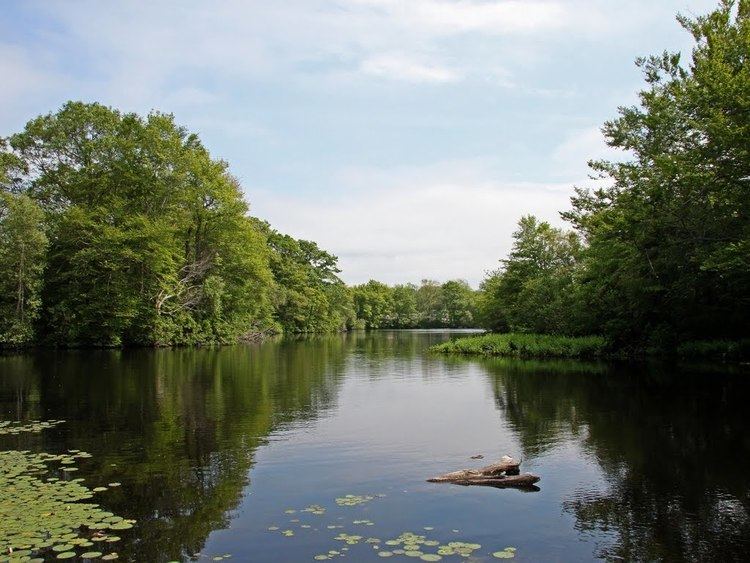
The event was designed to introduce people, who otherwise might be disinclined, to the North River. We spent the better part of an hour motoring upstream from Union Street to Route 3 and back again. Moving at a leisurely pace, we could really appreciate the beauty surrounding us: lush green marsh grass flanked with forest, the sometimes clear, sometimes cloudy sky reflected in the incoming tide.

I was reluctant at first to be a guide because even though I know a lot about the North River and the land that borders it, I know very little about the wildlife that makes its home in our watershed. I was afraid someone would ask me a question about birds for example, or fish, or even trees for that matter. While I know a duck from a wren, a pine from an oak, I’d be hard pressed to identify much more than that.

“What kind of fish can be caught in the river,” someone might ask. “Striped bass, . . . “ I’d begin, and then fumble. “Um, herring? . . . Shad?” Luckily, my boat captain had the fish and wildlife categories covered. He pointed out the red tailed hawks and cormorants, while I explained what the river valley looked like a hundred years ago.

Being out on the water reminded me that, even though it’s now been two years since I’ve even gone near my kayak, spending time on the North River is still something I enjoy very much. I’ll be swimming in the river for sure this summer, and if I get my act together, I’ll haul the kayak out of the barn and spend a morning on the water.

You might do the same.

In the summer, I prefer the more remote sections of the river system. The main stream of the North River, from Route 3 down to the Spit and the river mouth, can be quite crowded this time of year, especially with motor boat traffic. But upstream of Route 3, the river is significantly less congested, even on holidays and weekends.

To make the most of your paddling trip, it is important to know where and when to launch your boat. The river is influenced by the ocean’s tides, and boating trips can be challenging if they are not planned well, especially in narrow places such as bridges and railroad abutments.

For canoe and kayak access to the upper reaches of the North River, as well as Herring Brook and a small section of the Indian Head River, try the Hanover Canoe Launch (Riverside Drive, off Elm Street) on the Indian Head River. Paddling downstream, you will pass through a freshwater marsh. You have the option of staying in the marsh and exploring Herring Brook (to the right), which grows quite narrow, or heading down the wider North River (to the left).

If you prefer a quiet trip encountering very few (if any) fellow boaters, try Herring Brook. Birders and nature enthusiasts love this stream for the diverse flora and fauna to be observed there. Plan to be there during high tide, which reaches the upper part of the river 2.5 to 3 hours after the ocean high tide. If you arrive 1-2 hours before high tide reaches the launch site, you will have several hours to explore the area. As the tide goes out, the water level drops, and obstacles such as rocks and fallen trees emerge, so plan accordingly.

Another option is to head down the North River, a wider, more “public” stream. The upper reaches of the North tend to be quiet as well, at least as far downstream as the Washington Street bridge.

For a short trip in the upper reaches of the North River, plan to set out a couple hours before high tide at the launch site (remember that’s 2-3 hours after the ocean high tide). Paddle as far downstream as you like, but remember that you may be paddling against the outgoing tide on the way back. Be particularly careful at the old stone bridge at Washington Street. If the tide is flowing against you as you attempt to pass under it, you will have to work very hard to make your way through.

For a longer trip, it is best to drop off a car at another launch downstream. If you leave the Hanover Canoe Launch in the 1-3 hours before high tide, you may be able to ride the outgoing tide all the way downstream to the Union Street Bridge or even Damon’s Point. For a much shorter one-way trip, you can exit the river in Pembroke (see below). You may wish to explore Third Herring Brook (to your left) along the way.

All of the areas mentioned above are also accessible from the Pembroke Canoe Launch, located on Brick Kiln Lane, off Route 139. Launching from Pembroke 1-2 hours before high tide allows you to explore either upstream or down, and make it back before the tide goes out. (High tide at Pembroke is 2-2.5 hours after the ocean high tide).

Boating Safety:

Make your paddling trip safer and more enjoyable by following a few precautions:

• The Coast Guard requires that personal flotation devices (PFDs) must be worn from October to May, and carried in the boat -- one for each person -- the rest of the year. Children should wear PFDs at all times.

• Pay attention to wind and tides. Blustery days can make for unpleasant paddling trips, especially when the wind stirs up waves. When the wind is blowing against you, it may not matter that the tide is in your favor.

• Be prepared. A map of the river, an extra paddle, a first aid kit, and rope are all important supplies to bring along, as well as the drinking water, sun protection, and foul weather gear you would carry on any outdoor excursion.

by Kezia Bacon Bernstein, Correspondent
July 2001

Kezia Bacon Bernstein's articles appear courtesy of the North and South Rivers Watershed Association, a local non-profit organization devoted to the preservation, restoration, maintenance and conservation of the North and South Rivers and their watershed. For membership information and a copy of their latest newsletter, contact NSRWA at (781) 659-8168.