Showing posts with label Norris Reservation. Show all posts

Friday, September 19, 2014

Walking with Friends

The trails at Norwell's Norris Reservation are wide enough for two people to walk side by side.
-->
While attending a memorial service for a friend in August, it occurred to me how walking together – and the conversation that usually takes place while we’re on foot and side by side – tends to enhance relationships. It might be two friends, or it might be romantic partners, or it might be some other configuration, via family or work. But especially when these walks become a regular happening, when they provide a weekly (or monthly or quarterly . . . ) time to check in with one another, the two people involved not only grow closer to each other, but also gain valuable insight into their own selves.

One of the eulogists for my friend related a story along those lines. She and our mutual friend had gotten to know each other when their children were infants -- new mothers pushing their strollers together around town. In later years, they would meet for walks in the woods, or on the beach, and their “walkies” (spoken in a British accent) became a steady and reliable way to keep in touch, and help one another remain grounded as they navigated the various channels through which their lives led them. I was touched by the story, and – since I too have been fortunate to develop a number of friendships by walking together -- it got me wondering if this is universal theme.

I suspect that it has something to do with one’s mind being dually occupied. Walking requires a certain amount of energy. The conversation often fuels the steps, but at the same time, the steps fuel the conversation. It’s different from sitting and enjoying a cup of coffee together. Perhaps it’s because we’re not looking at each other – instead we’re watching where we are going. There is a sense of freedom – to let the mind wander, to try out new ideas, perhaps saying them aloud for the first time. Some of my most memorable -- and revelatory -- conversations have taken place on foot.

Autumn is probably my favorite time for walking. It’s neither too hot nor too cold. It’s neither muddy nor buggy. And the fields and forests tend to be really pretty – at least around here, as the leaves and grasses turn color and begin to fall.

The list that follows includes some of my favorite places to walk with a friend. These spots feature trails that are – at least some of the time – wide enough for two (conversation can become awkward when there is a leader and a follower). And they are large enough that one can take a decent, hour-long walk without retracing one’s steps. All feature beautiful landscapes as well. Pavement – while often convenient -- has a distinctly different feel from sand or grass or the forest floor.

Daniel Webster Wildlife Sanctuary - Winslow Cemetery Road, Marshfield. Fields, forests, boardwalks through a red maple swamp, plus the Green Harbor River. Managed by Mass Audubon.

Norris Reservation - Dover Street, Norwell. Numerous views of the North River and Second Herring Brook, with both cart paths and woodland trails. Managed by The Trustees of Reservations.

Nelson Memorial Forest/Phillips Farm Preserve - Union Street, Marshfield. Wide logging trails and narrower paths through forest with views of the salt marsh and the North River. Managed by New England Forestry Foundation and Wildlands Trust of Southeastern Massachusetts.

North Hill Marsh, Duxbury – Mayflower Street, Duxbury. Woodlands, wetlands and varying types of trails around bogs and a large, bird-friendly pond. Managed by Mass Audubon.

Willow Brook Farm Preserve – 99 Barker Street, Pembroke. A former farm, now mostly wooded, with boardwalks and also a meadow trail. Managed by and Wildlands Trust of Southeastern Massachusetts.

Luddams Ford/Indian Head River trails - Elm Street, Hanover. Follow the trail along a former railroad bed up one side of the Indian Head River. Take short detours toward the water for spectacular views. Managed by the Town of Hanover.

Whitney and Thayer Woods – Howes Lane, Cohasset. A huge network of cart paths and wooded trails, featuring glacial erratics (huge boulders) and some truly impressive rhododendrons. Managed by The Trustees of Reservations.

World’s End – Martin’s Lane, Hingham. This place has almost everything. Views of the ocean, the marsh, and Boston. Trails through the woods and across fields and along the shore. Wide trails, narrow trails, cart paths. Managed by The Trustees of Reservations.

Humarock/Rexhame Beach – Scituate and Marshfield. Many local beaches, due to geography, tidal restraints, or property lines, don’t permit much of a walk. But whether you enter from Humarock, near Fourth Cliff, or Marshfield, via Rexhame Beach, you will be able to cover a lot of ground.

Green Harbor/Duxbury Beach – Marshfield and Duxbury. High tide will impede your progress from Green Harbor, and without a sticker you will have to park at the inland side of the Powder Point Bridge, but if you time it right, you can walk for miles on what is probably the area’s most beautiful beach.

by Kezia Bacon
August 2014 
 
Kezia Bacon's articles appear courtesy of the North and South Rivers Watershed Association, a local non-profit organization devoted to the preservation, restoration, maintenance and conservation of the North and South Rivers and their watershed. For membership information and a copy of their latest newsletter, contact NSRWA at (781) 659-8168 or visit www.nsrwa.org. To browse 15 years of Nature (Human and Otherwise) columns, visit http://keziabaconbernstein.blogspot.com

Tuesday, August 27, 2013

Boys in the Woods

-->
The Teeple, Morey, Beal and Bernstein children prepare for a walk at Willow Brook Farm Preserve in Pembroke.

Anyone who reads this column regularly knows that I enjoy a good walk in the woods. Dedicated readers also know that I have a son, Abel, who is now seven years old. I’ve been taking Abel for nature walks since he was an infant – first in a Baby Bjorn carrier, then in a jog stroller, and later with him walking along beside me. He really enjoyed these outings when he was little. Now, not so much. “It’s boring, Mom.”

But last spring I figured out a way to make it less boring. Invite friends. Not just one or two, but a whole pack of them. Boys plus woods equals fun! So this summer I planned a few group nature walks, inviting some of Abel’s friends and their families to join us at some of the more child-friendly local conservation properties. And I was delighted to see that it worked. The boys had fun . . . and the adults enjoyed themselves as well.

Our first exploration was at the Norris Reservation on Dover Street in Norwell, which is managed by The Trustees of Reservations. I’d picked up this year’s South Shore Quests booklet, so we followed the route suggested there, looking for clues that would ultimately reveal where the Quests box was hidden (an opportunity for us to sign a guest book and stamp our Quest passport). The clues gave us a compelling reason to carry on, despite some wet weather, but I’m not sure we even needed the incentive. The boys were quite happy to be scampering up and down the trails, finding and carrying big sticks, and looking for snakes and frogs – they found plenty of the latter. I didn’t bother to try to teach them anything about the land we were exploring – except when they asked, and they had some good questions – but instead I just let them absorb the forest environment, and enjoy themselves. And they did.

Our second trip followed another South Shore Quest, this time at Willow Brook Farm Preserve on Route 14 in Pembroke (the property is managed by the Wildlands Trust of Southeastern Massachusetts). The weather was better, and the boys (plus a couple girls this time) once again found simple ways to entertain themselves. Climbing on boulders and fallen trees was as big a hit as climbing the tall wooden observation tower. But it seemed like simply moving in a pack – there were eight or nine children altogether – was the real attraction. Something primal was happening among those kids – they really enjoyed being outside together, following a trail and some basic “stay within my sight” type of rules, but otherwise being able to make their own fun. We went on from that excursion to a stop at The Blueberry Farm in Hanson, for Pick Your Own berries, which made the day even more special.

I’m hoping to continue these group nature outings throughout the year. I do understand how a simple walk in the woods, even with plenty of flora and fauna to investigate, might not be all that appealing to a youngster, but I think we’re onto something here, with the group dynamic. If anything, it's a welcome alternative to all of the other organized activities these children participate in. Dance/art/music classes, sports, martial arts – and of course school – all have their place, but it’s really nice to be outdoors with the kids, doing nothing in particular except following a trail through the woods or a meadow, and seeing what the children are inspired to do.

by Kezia Bacon
August 2013

Kezia Bacon's articles appear courtesy of the North and South Rivers Watershed Association, a local non-profit organization devoted to the preservation, restoration, maintenance and conservation of the North and South Rivers and their watershed. For membership information and a copy of their latest newsletter, contact NSRWA at (781) 659-8168 or visit www.nsrwa.org. To browse 15 years of Nature (Human and Otherwise) columns, visit http://keziabaconbernstein.blogspot.com

Monday, April 21, 2008

Where Does All That Water Go?

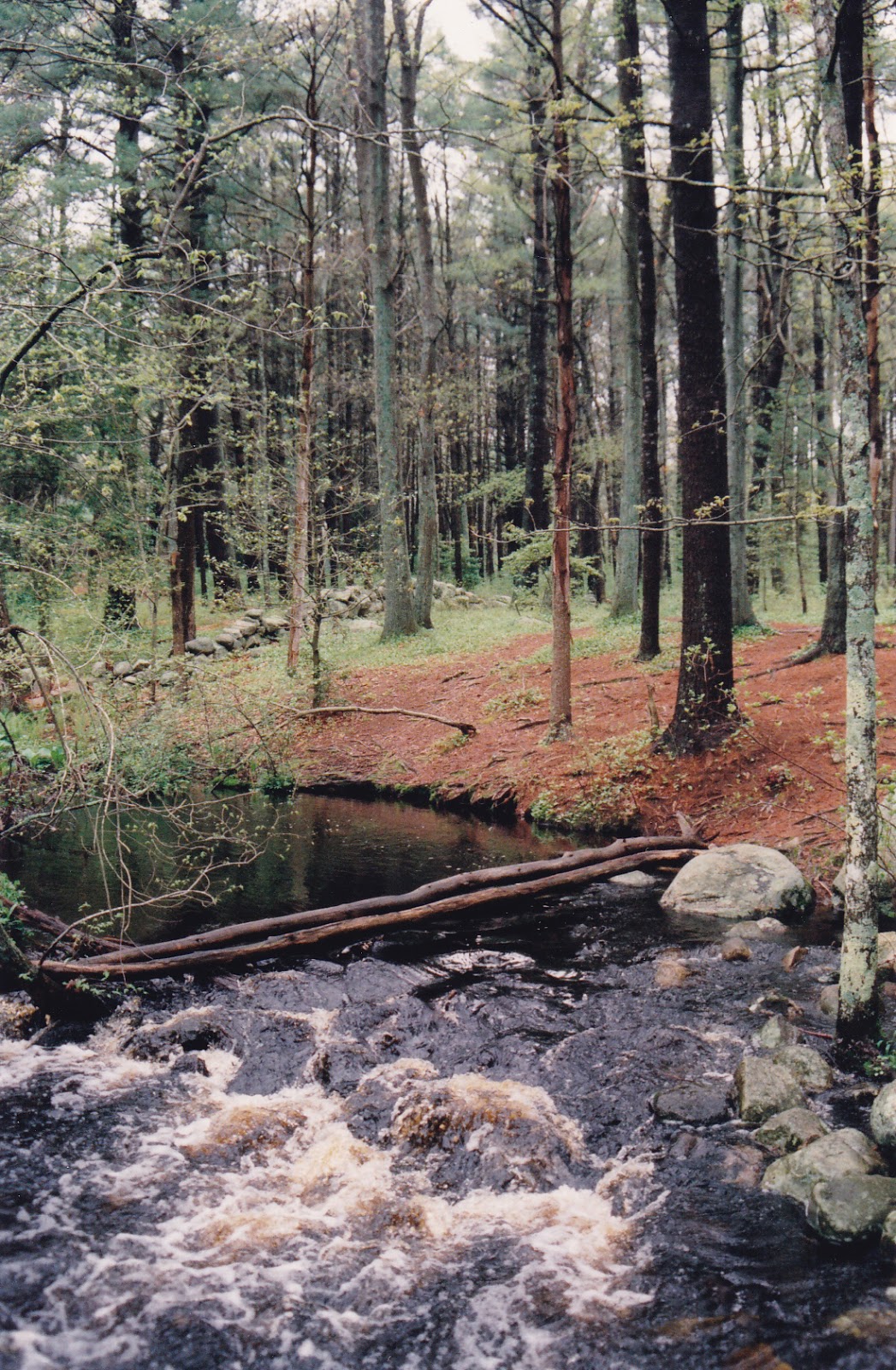
Second Herring Brook at the Norris Reservation in Norwell.
I probably would not have gone for a walk last Tuesday afternoon if I hadn’t remembered that Daylight Savings Time was due to begin. I’ve grown accustomed to taking a walk in the woods, along the river, or on the beach after work but now that the days are growing shorter, it will be all but dark when I leave the office at 5 PM. Walks will become morning and weekend events, as the return of Daylight Savings Time brings me back to my winter schedule.

This week’s walk took me to the Norris Reservation off Route 123 in Norwell. Managed by the Trustees of Reservations, this property is usually quite crowded at the end of the day, but with the rainy weather, the trails were practically deserted.

For those who may have forgotten, last weekend was the wet one. At least one Norwell resident measured six inches of rain on his backyard meter, and reports of local flooding were all over the news. Aside from some really big puddles however, I had yet to see any evidence of this influx of water. Driving over the North River around low tide on Monday afternoon, I noted that the river really didn’t look much different than usual.

My understanding of watershed mechanics changed as I walked down the path into the Norris Reservation. Through this 117-acre parcel flows Second Herring Brook, which drains Black Pond and a wide section of the eastern part of Norwell. Just below the mill pond on the property is a bridge, and below this bridge there is usually a quiet stream bubbling over the rocks, gently winding its way through the woods and emptying into the North River.

Last Tuesday it was different. I could hear the roar of the water as soon as I stepped down the path. Reaching the pond I was startled to see that both the pond and the brook had overflowed their banks, and that the quiet stream had turned into a raging torrent. A picnic table placed on a slight rise which usually affords a nice view of the brook was surrounded by swirling water. There was evidence that the flooding had been much worse the day before, as channels had been cut in the forest floor as the pond water attempted to escape its boundaries.

Thus my lesson in watershed mechanics. When it rains like crazy for three days straight, what happens to all that water? Some of it is absorbed into the ground, sometimes immediately, other times it stands in puddles for a while before slowly sinking in. But most of it flows over land. Downhill, into the wetlands, creeks, and little brooks that feed larger brooks, and from there into rivers like the North and South. The rivers flow to the ocean.

In the larger bodies of water we might not notice as dramatic a change as in the smaller ones -- a gallon of water poured into the Atlantic is far less noticeable than the same gallon poured on your basement floor -- but the change still occurs. The water has to go somewhere. While I could not detect much of a change in the North River estuary along Route 3A in Scituate, the difference in Second Herring Brook, one of its tributaries, was plain to see.

Driving home later that day I paid much more attention to the little brooks and streams that pass, unannounced, under our roads and highways. All of them were swollen, overflowing their banks and leaving big puddles in their wake. As I reached the South River in Marshfield Center I could hear the water raging in the distance. Looking upstream, I saw a most unusual sight. Veterans Memorial Park was under water! Furnace Brook and the upper reaches of the river were so full of water that they had flooded the park.

The area drained by a river or river system is known as a watershed. Basically, any rain that falls within the boundaries of a watershed stays within that watershed until it flows to sea. Portions of the towns of Abington, Duxbury, Hanover, Hanson, Hingham, Marshfield, Norwell, Pembroke, Rockland, Scituate, Weymouth, and Whitman drain into the North and South Rivers. While most of this drainage occurs in subtle ways, we really notice it when there’s a heavy rainfall.

by Kezia Bacon
November 1996

Kezia Bacon is the Assistant Director of the North and South Rivers Watershed Association (NSRWA).